Most Australian homeowners can relate to the annoyance of going into the garage, but seeing an inch of dust lying around everywhere. You brush it, you spray it, and after a few days, the dust is back. The solid-looking concrete floor has turned into a permanent mess-maker. It is not only an issue of appearances, and this is a widespread issue. A failing concrete floor may turn your garage into an unwelcome place to work and even affect your home’s value. This paper will discuss the reasons why this occurs and look at one of the feasible solutions: residential resin flooring. You are going to know what the resin flooring residential cost in Australia is and whether it is worth investing in it.
Why Your Garage Floor Is Dusty and Hard to Clean
A dusty concrete floor is an indication that the floor is gradually crumbling. This will make you realize why certain solutions are more effective than others.
How Concrete Breaks Down Over Time
Concrete might seem to be hard and resolute, yet the surface is porous and weak. The top layer is worn, and cracks are formed by the regular traffic of feet as well as vehicle tyres over time. This disperses particles of cement and sand, the dust that you see settling on surfaces. Concrete is also filled with moisture, which rises through the slab. When this moisture is released to the surface, it transports dissolved minerals to the surface as a white powdery efflorescence. This is a never-ending cycle, so that an untreated concrete floor will continue to produce dust.
Why Oil and Water Make It Worse
Two of the largest adversaries of bare concrete are oil and water. Whenever engine oil, transmission fluid or simple water falls on the floor, the concrete acts as a sponge. As soon as a stain infiltrates, it is almost impossible to get out. Most of the oils are also composed of acids and chemicals, which gradually corrode the cement holding the concrete in place. This chemical reaction makes the surface softer, and it is even more likely to crumble and turn into dust. What comes out is a floor that appears so dirty permanently and yet it keeps on getting worse.
How Resin Seals and Protects Concrete
Resin flooring operates on the principle of forming a solid and non-porous surface on top of the current slab of concrete. The resin, unlike paint, does not just sit on the surface, but is chemically bonded to the prepared concrete to create one layer. This bond prevents the shedding of the concrete dust since the surface is now covered by some plastic-like material. Oil and water cannot percolate through resin since resin is totally impermeable. The spills remain on the surface where they can be wiped off. The resin also prevents an increase in moisture through the slab and removes efflorescence. When it has been applied, the concrete below is also safeguarded against further wear and damage caused by chemicals.
What Is Residential Resin Flooring
Residential resin flooring is a coating system that is a liquid applied onto concrete floors in residential buildings. It is produced using plastic polymers, which harden to create a smooth surface. Although the resin floors have been in place in the industrial facilities for many years, the resin technology has gained popularity in Australian garages, workshops and even interior living areas. Resin floors are not uniform and the kind you purchase will influence the performance and the price of resin flooring.
Epoxy: Strong and Budget-Friendly
Australian homes use epoxy as the most common resin flooring. It is made up of a resin and a hardener combined and applied. The liquid is turned into a solid, tough plastic surface using a chemical reaction. This is in regard to a typical home garage flooring installation of a standard size of a double garage in Australia, with the costs of the epoxy flooring being between $1080 and $3600 AUD, depending on finish and coats. Epoxy is a great oil-resistant, hot tyre pickup and daily wear item. It may be flaked with colour to give a decorative effect. The first weakness is that normal epoxy will crack with time and turn a little yellow in direct sunlight.
Polyaspartic: Fast-Curing and UV Stable
Polyaspartic is a more sophisticated resin coating, which dries incredibly fast. Polyaspartic systems may be tack-free in as little as 30 to 45 minutes and a garage floor could be put into service on the same day as opposed to the multiple days it took epoxy. The rapid turnover is useful to busy families. Polyaspartic is also 100% UV stable, so it will not yellow or chalky even in garages with big windows or open doors. The trade-off is that polyaspartic systems are normally more expensive than epoxy, commonly between $40 and $130 per square metre installed. The extra cost is offset by the convenience and durability over time for many homeowners.
Polyurethane: Flexible and Impact-Resistant
Polyurethane resin is appreciated due to its flexibility. Polyurethane has a slight give, unlike epoxy, which is hard and thus is more comfortable to stand on. This also contributes to its being less vulnerable to impact damage. A polyurethane floor will not chip and crack as easily as a drop of a heavy tool. Polyurethane is frequently applied as a topcoat on epoxy systems due to the fact that polyurethane is highly resistant to scratches and offers some extra UV protection. The price of polyurethane systems in residential resin flooring typically ranges between polyaspartic and epoxy, but the costs depend on the thickness and the way of use.
Real Cost Breakdown of Resin Flooring
The real cost of resin flooring can only be determined by going beyond a mere price per square metre. The final bill is affected by a number of factors.
Professional epoxy installation in Australia normally costs between 30 and 150 Australian dollars per square metre. This variety indicates variations in the quality of materials used, the number of coats and ornamental finishes. Simple two-coat finishes over concrete that has been properly prepared may cost $30 to 35 per square metre, or ornamental full-flake finishes may go up to 100 or more per square metre.
The most ignored cost is surface preparation. When your concrete has cracks, old paint, or even considerable staining, you must grind it and repair it prior to resin being applied. This is preparatory work that may increase the total cost by $5 to $15 per square metre. Preparation of older homes with broken slabs might be costlier than the resin materials themselves.
Project size also affects pricing. Larger areas often cost less per square metre because contractors can spread their setup costs across more space. A single-car garage might cost around $80 per square metre, while a double garage might drop to $60 per square metre. For those wondering about resin flooring cost per sq ft, this translates to between $3 and $14 for professionally installed systems, though Australian quotes are almost always provided in square metres.
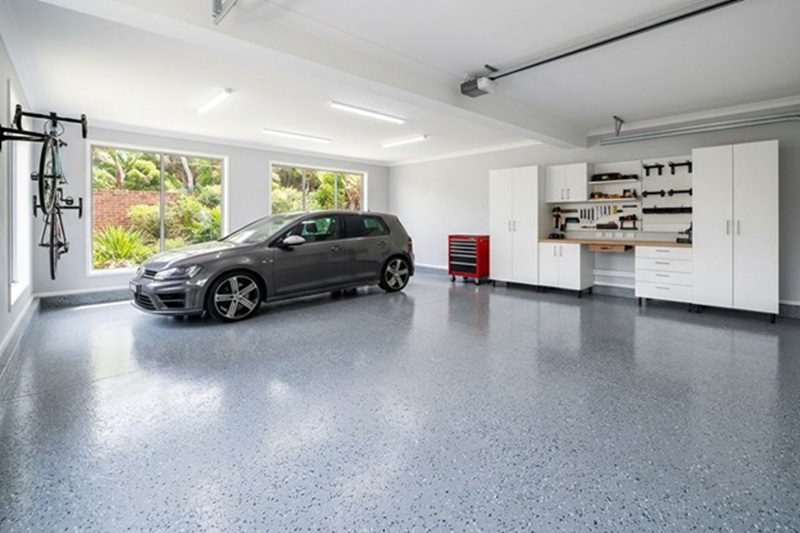
Other aspects that influence resin flooring residential price are anti-slip additives, bespoke colour matching and long-term warranty. The actual cost of a typical 36-square-metre double garage should be in the range of $1200 to $3600 AUD.
DIY vs Professional Installation
The appeal of doing it yourself is understandable. DIY epoxy kits for a double garage can be purchased for $100 to $500 at hardware stores, which seems like a significant saving. Some Australian homeowners have successfully used products like the Sikafloor 264 DIY kit to achieve acceptable results.
However, the true cost of DIY is often higher than it first appears. Surface preparation equipment should be either hired or bought on its own. Industrial vacuums and concrete grinders are not typical household equipment. The most common cause of failure of resin flooring is poor surface preparation. Unless the groundwork of the concrete is performed correctly, the resin will start peeling after a few months. According to many contractors, it is more expensive to fix DIY failures than it would be to do the job right the first time.
Professional installation generally costs an extra $20 to 40 per square metre on top of material costs, but takes much more than labour to cover. Professional installers carry with them commercial grade equipment, experience in moisture testing, and apply finishes in a smooth way. They also offer warranties that safeguard your investment.
How Resin Flooring Adds Value to Your Home
A professionally laid resin floor can truly add value to your property. According to Australian real estate agents, a neat, tidy garage is a deluxe during an open inspection. The negative impression formed by having a stained and dusty concrete floor can tint the perception of the buyers towards the rest of the property. A shiny, smooth resin floor is an indication that the house has been well kept.
Beyond visual impact, resin flooring offers functional benefits buyers recognise as valuable. The chemical resistance protects against future oil stains. The seamless surface means no grout lines where dirt accumulates. For families who use the garage as a workshop, gym, or additional living space, a resin floor transforms an unpleasant area into a usable room.
Easy Maintenance and Long-Term Savings
A resin floor is virtually free to maintain once installed, other than regular cleaning. A gentle broom or a vacuum helps to remove dust and debris. To clean even better, a mop with warm water and light detergent is all that is required. Waxing or polishing is not necessary.
The cost of resin flooring for house projects extends beyond installation, but this is where resin proves its worth. With proper care, epoxy floors can last 10 to 20 years or more. Polyaspartic systems may last even longer. When the surface eventually shows wear, it can be refreshed with a new topcoat rather than requiring complete replacement. The garage resin flooring cost is an investment that pays dividends through improved home value and reduced cleaning effort.
Conclusion
One of the issues that plagues many Australian houses is a dusty, stained garage floor. Concrete is porous and its porous surface traps oil and moisture, which accelerates the damage since the material is porous and breaks down over time. The solution to this is resin flooring, which covers the concrete with a hard and non-porous layer to avoid the production of dust and further staining.
Homeowners need to consider more than just the first cost of resin flooring when considering its residential price. Most garages can be covered with epoxy, which is cheap and durable, whereas polyaspartic and polyurethane can offer better performance. Professional installation will provide a solution that is going to last for decades with minimal maintenance. Resin flooring is a viable long-term solution for Australian families fed up with living with concrete dust.