Managing vehicle access is an important part of keeping a property secure, organised, and easy to use. Whether it is a busy commercial car park, apartment complex, warehouse, office building, or private residential community, controlling who enters and exits the site can make a noticeable difference.
One of the most practical solutions is a boom gate. These automated barriers provide a simple way to manage vehicle movement while creating a clear entry and exit point. However, with different types, operating systems, and security features available, choosing the right option requires some thought.
If you are considering boom gates for a commercial or residential property, understanding the key factors can help you make a more informed decision.
What Are Boom Gates?
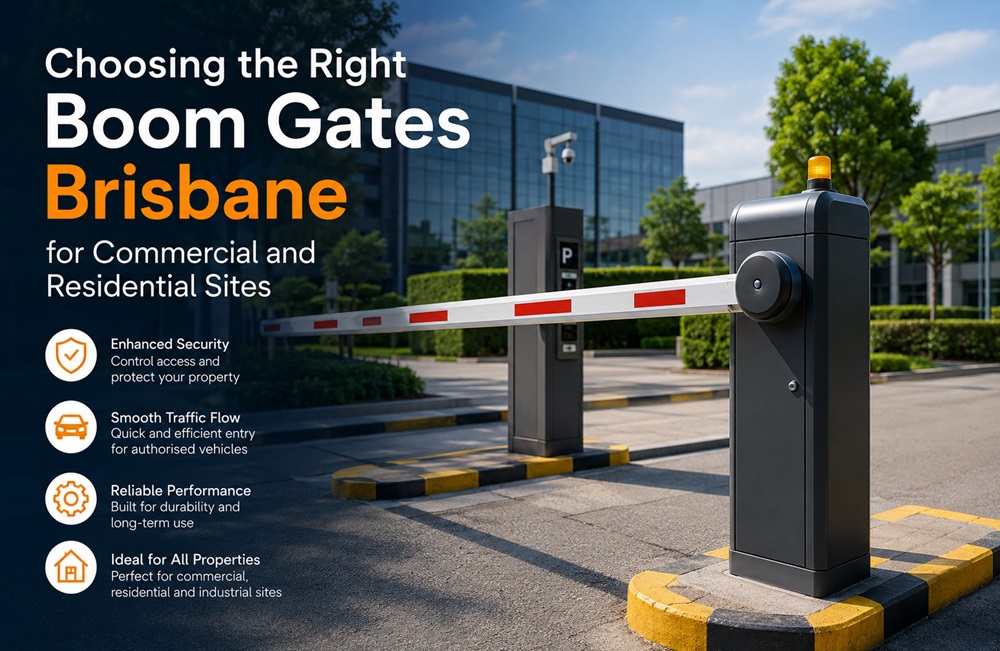
Boom gates are automated barriers designed to control vehicle access to a particular area. A horizontal arm is raised or lowered to allow authorised vehicles through. Depending on the system, the gate can be operated using a remote control, access card, keypad, ticketing system, intercom, licence plate recognition, or other automated technology.
Unlike traditional gates, boom barriers are particularly useful where vehicles need to move through an entrance regularly. They provide controlled access without requiring drivers to stop and manually open a large gate.
This makes them suitable for car parks, industrial facilities, residential complexes, commercial properties, schools, hospitals, and other locations where vehicle access needs to be monitored.
Why Are Boom Gates Useful for Commercial Properties?
Commercial sites often experience a high volume of vehicle traffic. Employees, customers, contractors, delivery drivers, and visitors may all need access throughout the day.
A properly designed access control system can help reduce confusion and improve security. For example, a business may use access cards for employees while providing temporary access for visitors or contractors.
Modern boom gates systems can also be integrated with other security technologies. CCTV cameras, intercoms, access control software, and automatic number plate recognition can work together to provide greater visibility over vehicle movements.
For businesses, this can be especially valuable when managing restricted parking areas or protecting warehouses and industrial facilities.
Why Residential Properties Use Boom Gates
Boom barriers are not limited to commercial applications. They can also be highly effective in residential environments.
Apartment buildings, gated communities, retirement villages, and private residential estates may use boom gates to prevent unauthorized vehicles from entering shared areas.
Residents can be provided with remotes, access cards, keypads, or mobile-based access depending on the system installed. Visitors can be granted temporary access through an intercom or reception system.
This creates a controlled entry point without making access unnecessarily difficult for residents and their guests.
Consider the Level of Traffic
One of the first things to consider is how frequently the boom gate will be used.
A small residential complex with limited daily traffic may not require the same heavy-duty equipment as a busy commercial car park. On the other hand, a warehouse or shopping centre entrance may experience hundreds or even thousands of vehicle movements each day.
The expected traffic volume can influence the type of motor, barrier arm, operating speed, and overall system durability required.
Choosing equipment based only on the purchase price can become expensive if the system is not designed for the amount of traffic it receives.
Think About Security Requirements
Every property has different security needs. A residential driveway may require basic access control, while a commercial facility storing valuable equipment may need a more comprehensive solution.
When comparing boom gates options, consider how access will be authorised and monitored.
Some common access methods include:
- Remote controls
- Keypads and PIN codes
- Proximity cards
- RFID tags
- Mobile applications
- Intercom systems
- Licence plate recognition
- Integrated access control systems
The right choice depends on the property, number of users, desired security level, and available budget.
Choosing the Right Barrier Arm
Boom gate arms are available in different lengths to suit different entrances. The required arm length will depend on the width of the driveway or access lane.
It is important to select an appropriate size rather than assuming that a longer arm is always better. A properly sized barrier can operate efficiently while reducing unnecessary stress on the mechanism.
Some sites may also require additional safety features, particularly where pedestrians and vehicles share the same area.
LED lighting, reflective strips, warning signs, sensors, and safety loops can improve visibility and help reduce the risk of accidents.
Speed Matters in Busy Areas
The operating speed of a boom gate can have a major impact on traffic flow.
At a busy commercial entrance, a slow barrier can create queues during peak periods. In a residential complex, however, extremely fast operation may not be necessary.
The ideal operating speed should balance convenience and safety. Faster is not automatically better. The system needs enough time to detect vehicles and pedestrians and operate safely.
Before installation, consider when the property experiences the highest traffic volumes and choose equipment accordingly.
Integration With Access Control Systems
Modern boom gates can often be connected with wider security systems. This is one of the reasons they have become increasingly popular for commercial and residential applications.
For example, a commercial building could connect its barrier to an employee access card system. When an authorised card is detected, the boom gate opens automatically.
A residential complex could use a combination of resident access cards and an intercom system for visitors.
For larger facilities, access records can also help property managers understand who entered and exited the site and when.
When considering boom gates, it is worth thinking about future integration rather than focusing only on the physical barrier.
Installation Location Is Important
The location of the boom gate can affect both performance and safety.
There should be enough space for vehicles to approach, stop, and pass through comfortably. The barrier should also be positioned where drivers can clearly see it.
Drainage, lighting, nearby structures, pedestrian walkways, and traffic direction should all be considered during the planning stage.
For commercial properties, it may also be necessary to assess whether trucks, vans, or other large vehicles will use the entrance. Their turning radius and height requirements can affect the final design.
Professional installation can help identify potential problems before the system is installed.
Maintenance Should Not Be Overlooked
Like any mechanical access system, boom gates require regular maintenance.
Dust, weather exposure, frequent operation, accidental impact, and general wear can affect performance over time. Routine inspections can help identify issues before they result in complete system failure.
Maintenance may include checking the motor, barrier arm, sensors, safety systems, control equipment, and electrical connections.
For high-traffic commercial sites, scheduled servicing can be particularly important because unexpected downtime can disrupt business operations.
Residential vs Commercial Boom Gates
Although the basic principle is the same, commercial and residential installations often have different priorities.
Residential properties generally focus on convenience, controlled access, quiet operation, and ease of use for residents.
Commercial properties may prioritise durability, high operating cycles, traffic management, detailed access records, and integration with existing security systems.
There is no single boom gate solution that works perfectly for every property. The best system is one that matches the site’s traffic, security requirements, layout, and daily operating conditions.
Choosing a Reliable Installation Provider
The quality of the installation can be just as important as the equipment itself. A good system needs to be correctly positioned, configured, tested, and integrated with other access control components.
When comparing providers, look at their experience with similar properties and ask what support they provide after installation.
It can also be useful to discuss future servicing, repairs, replacement parts, software updates, and system upgrades before making a decision.
A reliable provider should be able to assess your property and recommend a solution based on its actual requirements rather than simply selling the most expensive equipment.
Final Thoughts
Choosing the right boom gate involves more than selecting a barrier and motor. The ideal system should provide a balance of security, convenience, reliability, safety, and long-term value.
Whether you are managing an apartment complex, office building, warehouse, industrial facility, or private residential community, carefully assessing traffic levels, access requirements, barrier size, operating speed, safety features, and technology integration can help you choose a system that works effectively.
For property owners and managers looking at boom gates Brisbane, professional advice can make the selection and installation process considerably easier. With the right planning and equipment, a boom gate can become an important part of a property’s overall access control strategy.
Ultimately, the best investment is not necessarily the cheapest system. It is the one that is reliable, appropriately designed for the property, simple for authorised users, and capable of meeting your security and access requirements for years to come.